
- Water & Waste Water
- Food –Microbiological, Chemical & Nutritional Labelling
- Soil & Sludge
- Shelf Life Analysis
- Cleaning Materials, Toiletries & Detergents
- Cosmetics & Personal Care Products
- Halal, Meat Identification, Porcine Content, GMO Analysis
- Tissues, Paper & Paper Products
- Migration/Food Contact Material Test
- Waterproofing Membranes & Bituminous Products
- Adhesives, Sealants, Self Adhesive Tapes
- Tiles, Marble, Granite, Natural Stone & Paving Blocks
- Paint Testing
- Geotextile & GeoMembranes
- Aluminium Composite Panels, Insulation & Cladding Materials, Glass, Wood & Wood Based Panels.
- Rubber, Silicone, Plastic & Polymer Materials
- Microbial Environmental Monitoring
- Corrosion Analysis Or Corrosion Testing
- Glass-Reinforced Plastic (GRP) Testing
- Foam Testing
- Toy Testing
- Legionella Risk Assessment
- Adhesion Testing
- Child Care Products Testing Dubai
- Pharmaceutical Testing
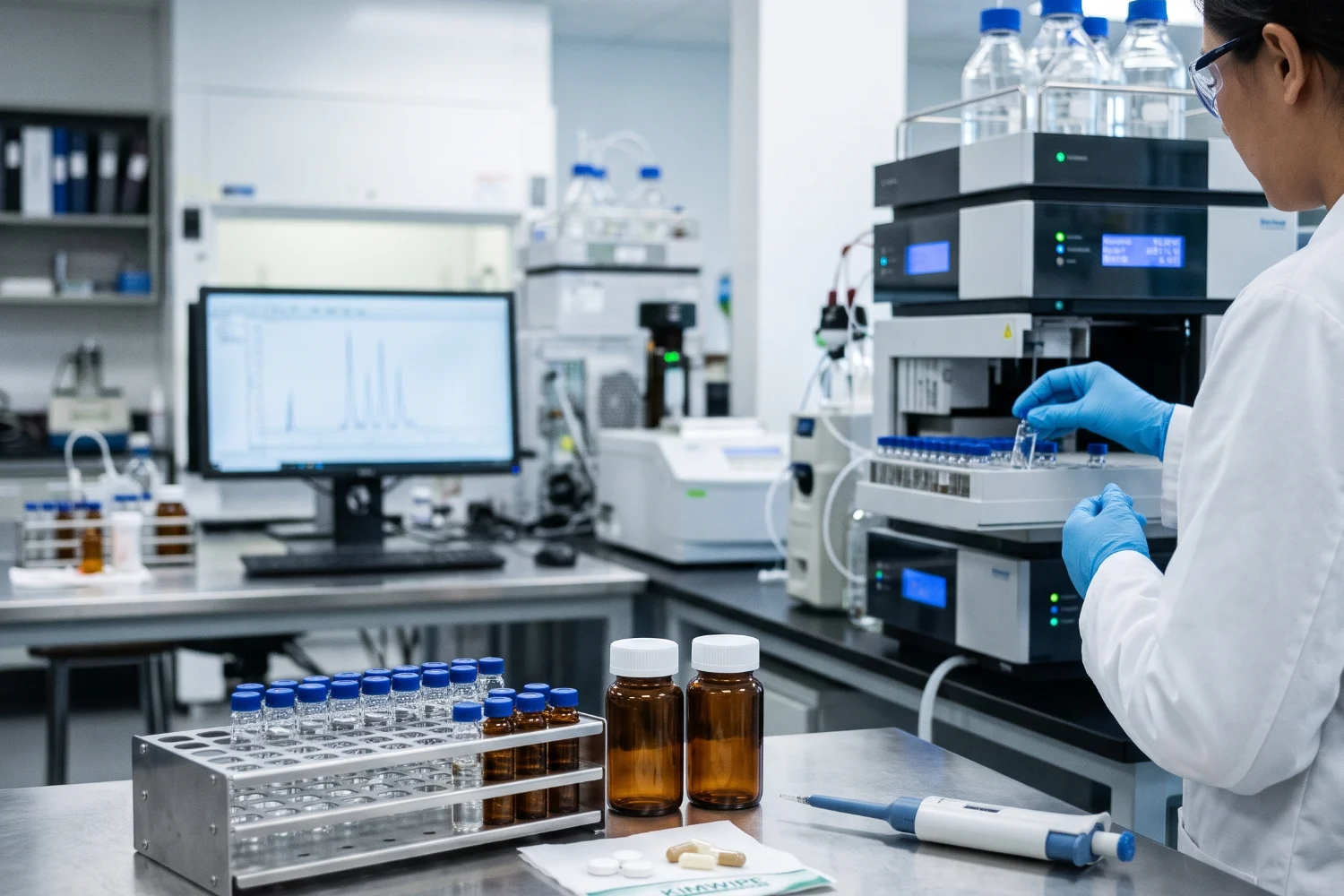
Testhub Laboratories provides pharmaceutical testing services across the UAE for raw materials, active pharmaceutical ingredients (APIs), excipients, finished dosage forms and packaging materials. Services cover physical and chemical testing, microbiological testing, stability testing to ICH guidelines and specification compliance testing against pharmacopoeial standards such as USP, BP and Ph. Eur.
Pharmaceutical testing confirms that a medicine is what it claims to be, contains the right amount of active ingredient, is free from harmful contamination and stays stable throughout its shelf life. Testhub supports pharmaceutical manufacturers, importers, distributors, contract manufacturers and healthcare companies across the UAE with pharmaceutical analysis using validated methods, experienced analysts and clear, defensible test reports.
Whether you are releasing a batch, qualifying a new supplier, supporting a product registration or investigating a quality complaint, our laboratory gives you data you can rely on.
Products and materials we test
- Active pharmaceutical ingredients (APIs) and intermediates
- Excipients and inactive ingredients
- Tablets, capsules and powders
- Syrups, suspensions, solutions and oral liquids
- Creams, ointments, gels and other topical products
- Injectables and other sterile preparations
- Ophthalmic and nasal preparations
- Nutraceuticals, food supplements and herbal medicines
- Primary packaging materials (containers, closures, blister foils)
Our Pharmaceutical Testing Services
Physical and chemical testing
Physical and chemical testing verifies identity, strength, purity and performance of a pharmaceutical product.
- Identification and characterisation:confirms the identity of ingredients using techniques such as HPLC, UV-Vis and FTIR spectroscopy.
- Assay and API content: measures how much active ingredient is present against the label claim.
- Impurities and related substances: detects and quantifies degradation products and process impurities.
- Dissolution testing: measures how quickly and completely the active ingredient releases from a tablet or capsule (USP <711>).
- Disintegration testing: checks that tablets and capsules break apart within the specified time (USP <701>).
- Uniformity of dosage units: confirms each unit contains a consistent amount of active ingredient (USP <905>).
- Weight variation: checks unit-to-unit consistency in tablet and capsule weight.
- pH determination: for solutions, suspensions, injectables and topicals (USP <791>).
- Moisture content and loss on drying: by Karl Fischer titration or loss on drying (USP <921>, <731>).
- Viscosity and density: for liquids, semi-solids and topical formulations.
Microbiological testing
- Microbial limit testingfor non-sterile products (USP <61>, <62>; Ph. Eur. 2.6.12, 2.6.13)
- Total aerobic microbial count (TAMC)
- Total yeast and mould count (TYMC)
- Specified microorganisms, such as E. coli, Salmonella, Pseudomonas aeruginosa, Staphylococcus aureus and Candida albicans
- Sterility testing for injectables and sterile products (USP <71>; Ph. Eur. 2.6.1)
- Bacterial endotoxins testing (BET/LAL) (USP <85>; Ph. Eur. 2.6.14)
- Microbial identification of isolates for investigations
- Preservative efficacy testing, also called antimicrobial effectiveness testing (USP <51>), where applicable
Stability testing
- Long-term stability studies under conditions that reflect the intended market. For hot and humid climates such as the UAE, long-term conditions of 30°C / 75% RH are commonly used.
- Accelerated stability studies, typically at 40°C / 75% RH
- Intermediate stability studies, typically at 30°C / 65% RH, where required
- Photostability testing following ICH Q1B
- Stability-indicating analytical methods that separate the active ingredient from its degradation products
- Shelf-life evaluation with scheduled pull points and supporting analytical testing
Raw material testing and finished product testing
- Identification of incoming raw materials
- Purity and assay determination
- Physical and chemical characterisation
- Microbiological quality assessment
- Compliance testing against pharmacopoeial monographs, in-house specifications or client specifications
Why pharmaceutical testing is important
- Patient safety: detects contamination, impurities and incorrect dosing before a product reaches patients.
- Regulatory compliance: supports product registration and GMP requirements set by UAE regulators, including the Emirates Drug Establishment (EDE), which has taken over pharmaceutical regulation from the Ministry of Health and Prevention (MOHAP).
- Batch release and consistency: confirms each batch meets its specification.
- Supplier qualification: verifies that raw materials from new or existing suppliers meet quality requirements.
- Shelf-life assurance: stability data justifies expiry dates and storage instructions.
- Investigations: independent data helps resolve out-of-specification (OOS) results, complaints and recalls.
Standards and guidelines we follow
- United States Pharmacopeia (USP)
- British Pharmacopoeia (BP)
- European Pharmacopoeia (Ph. Eur.)
- ICH guidelines (Q1A(R2) and Q1B for stability; Q2 for method validation)
- GCC and UAE regulatory requirements
- Client-specific and in-house validated methods
How to get your pharmaceutical products tested
- Contact us with your product details, the tests you need and the specification or pharmacopoeia to test against.
- Receive a quotation with the test scope, sample quantity required and turnaround time.
- Submit samples with a completed sample request form, batch details and certificate of analysis, if available.
- Testing and review: our analysts test the samples with validated methods and every result is technically reviewed.
- Receive your report: a clear test report with results, specification limits and a pass/fail statement where applicable.
Industries we serve
Pharmaceutical manufacturers, contract manufacturing organisations (CMOs), importers and distributors, hospitals and pharmacies, nutraceutical and supplement brands, herbal medicine companies, and regulatory and procurement teams.
Why Choose Testhub for Pharmaceutical Testing Services?
- One laboratory, full scope: chemical, microbiological and stability testing under one roof.
- Validated methods: pharmacopoeial and in-house methods validated for accuracy, precision and specificity.
- Experienced analysts: trained team with expertise in pharmaceutical analysis.
- Reliable turnaround: clear timelines agreed upfront.
- Data integrity: controlled records and technically reviewed reports.
- Support across the UAE: easy sample drop-off from across the UAE and direct access to our technical team.
Need pharmaceutical testing services in UAE? Contact Testhub Laboratories on +971 4 824 8015 or info@testhublab.com, or request a call back below.
FAQ
What is pharmaceutical testing?
Pharmaceutical testing is the laboratory analysis of drugs, raw materials and packaging to confirm their identity, strength, purity, safety and stability. It includes chemical tests such as assay and impurities, microbiological tests such as microbial limits and sterility, and stability studies that support shelf life.
What tests are done on pharmaceutical products?
- Common tests include identification, assay, related substances, dissolution, disintegration, uniformity of dosage units, weight variation, pH, moisture content, microbial limit tests, sterility, bacterial endotoxins and stability studies. The exact tests depend on the dosage form and the applicable pharmacopoeial monograph or specification.
What is physical and chemical testing of pharmaceuticals?
What is microbiological testing in pharmaceuticals?
Microbiological testing checks that a pharmaceutical product is free from harmful microorganisms. It covers microbial limit tests (TAMC, TYMC and specified organisms) for non-sterile products, sterility and endotoxin testing for sterile products, and preservative efficacy testing.
Where can I get pharmaceutical products tested in UAE?
Testhub Laboratories offers pharmaceutical testing services across the UAE for APIs, excipients, finished products and packaging materials. Contact the lab with your product details and required tests to receive a quotation.
What is a microbial limit test?
A microbial limit test measures the number of bacteria, yeasts and moulds in a nonsterile product (TAMC and TYMC) and checks for specified harmful organisms such as E. coli and Salmonella. It follows USP <61> and <62> or Ph. Eur. 2.6.12 and 2.6.13
What is the difference between sterility testing and a microbial limit test?
Sterility testing confirms that a sterile product, such as an injectable, contains no viable microorganisms at all. A microbial limit test is for non-sterile products and checks that microbial counts stay within acceptable limits.
How long does sterility testing take?
The sterility test itself requires an incubation period of at least 14 days under USP <71>, so results are usually available after about two to three weeks including sample preparation and reporting.
What is the bacterial endotoxin test?
The bacterial endotoxin test (BET), also called the LAL test, detects endotoxins from gram-negative bacteria that can cause fever and serious reactions when injected. It is required for injectables and many medical products.
What is stability testing in pharmaceuticals?
Stability testing studies how a product’s quality changes over time under defined temperature, humidity and light conditions. The results are used to set the shelf life, expiry date and storage conditions, following ICH Q1A(R2).
What are ICH stability conditions for the UAE?
The UAE falls in a hot and humid climatic zone, so long-term stability studies commonly use 30°C / 75% RH. Accelerated studies are typically run at 40°C / 75% RH.
What is dissolution testing?
Dissolution testing measures the rate and extent to which the active ingredient is released from a solid dosage form, such as a tablet or capsule, into a liquid medium. It indicates how the drug may be released in the body and checks batch-to-batch consistency.
What is preservative efficacy testing?
Preservative efficacy testing, or antimicrobial effectiveness testing, challenges a product with known microorganisms to show its preservative system can control contamination during use. It applies to multi-dose products such as syrups, eye drops and creams
How much does pharmaceutical testing cost in UAE?
Cost depends on the number of tests, the dosage form, the method required and the turnaround time. Contact Testhub with your product and specification for a detailed quotation.
Which regulator oversees pharmaceutical products in the UAE?
The Emirates Drug Establishment (EDE) is the federal authority for regulating pharmaceutical and medical products in the UAE, including registration and good practice compliance. It has taken over these responsibilities from the Ministry of Health and Prevention (MOHAP).