
- Water & Waste Water
- Food –Microbiological, Chemical & Nutritional Labelling
- Soil & Sludge
- Shelf Life Analysis
- Cleaning Materials, Toiletries & Detergents
- Cosmetics & Personal Care Products
- Halal, Meat Identification, Porcine Content, GMO Analysis
- Tissues, Paper & Paper Products
- Migration/Food Contact Material Test
- Waterproofing Membranes & Bituminous Products
- Adhesives, Sealants, Self Adhesive Tapes
- Tiles, Marble, Granite, Natural Stone & Paving Blocks
- Paint Testing
- Geotextile & GeoMembranes
- Aluminium Composite Panels, Insulation & Cladding Materials, Glass, Wood & Wood Based Panels.
- Rubber, Silicone, Plastic & Polymer Materials
- Microbial Environmental Monitoring
- Corrosion Analysis Or Corrosion Testing
- Glass-Reinforced Plastic (GRP) Testing
- Foam Testing
- Toy Testing
- Legionella Risk Assessment
- Adhesion Testing
- Child Care Products Testing Dubai
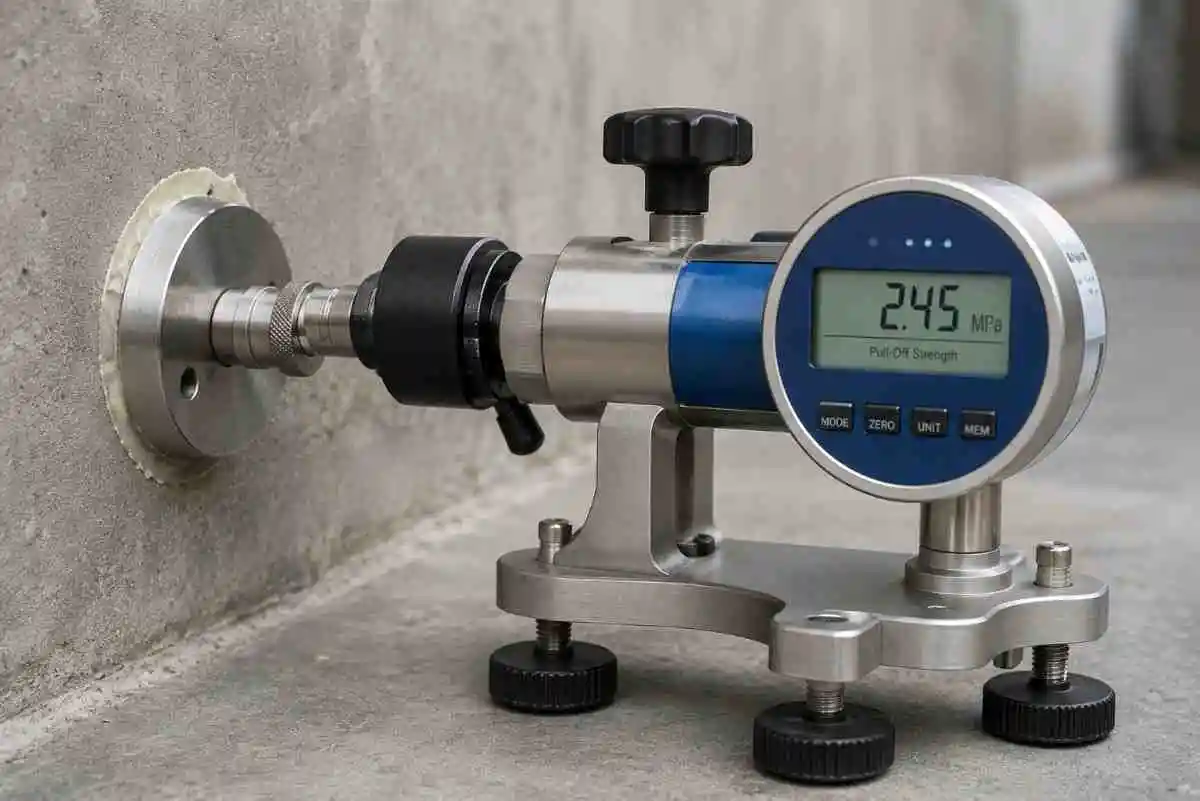
Evaluate the Bond Strength and Performance of Your Materials
Pull-off adhesion testing measures how well a coating, repair material, or bonded system holds to the surface beneath it. TestHub Laboratories carries out this testing across the UAE for coatings, concrete repairs, waterproofing membranes, tile adhesives, and FRP systems, producing a bond strength value in MPa, a recorded failure mode, and a report built to ASTM D4541, ASTM C1583, ISO 4624, and related standards.
We’re ISO/IEC 17025 certified, and every test is carried out by qualified civil and materials engineers, not subcontracted out, so the result you get back is one you can put your name to.
What is Pull-Off Adhesion Testing?
Pull-off adhesion testing measures the tensile bond strength between a coating, overlay, or repair material and the substrate it’s applied to. Here’s how it works:
- A loading dolly is bonded to the test surface
- A core is cut around it, where the standard requires
- A tester applies a steadily increasing tensile force until the bond fails
- The force at failure, divided by the dolly’s contact area, gives bond strength in megapascals (MPa)
The result does two things: it confirms whether the material bonded to specification, and it shows how the material failed under load, telling an engineer not just whether a bond passed, but why it failed if it didn’t.
Why is Pull-Off Adhesion Testing Important?
A coating or repair that looks fine on the surface can still be poorly bonded underneath, and that gap only becomes visible once it fails, usually after the project has closed out. Bond strength testing catches that gap before handover:
- Safety — a delaminating coating in a high-traffic or structural area is a hazard, not just a cosmetic issue
- Durability — a weak bond accelerates water ingress and corrosion
- Structural performance — in load-bearing repairs, adhesion directly affects how the repair performs under real loads
A documented result also gives contractors, consultants, and clients a verifiable data point instead of a visual judgement call, exactly what’s needed for acceptance sign-off and to confirm a specified minimum MPa value has actually been met on-site. It pairs naturally with corrosion testing on the same coated surfaces, since a weak bond and poor corrosion resistance often point to the same underlying problem.
Materials We Test
Coatings & Finishes
- Paints
- Protective coatings
- Epoxy floor coatings
- Cementitious coatings
- Resin flooring
For manufacturers checking formulation quality rather than site-applied bond strength, our separate paint and coating testing service covers gloss, hardness, and film thickness.
Repair & Bonding Materials
- Waterproofing membranes
- Concrete repair mortars
- Concrete overlays
- Cement screeds
- Tile adhesives
- Bonding agents
- FRP composite systems
- Polymer mortars
Membrane and bituminous products can also go through our dedicated waterproofing testing scope, and FRP systems through our glass fiber reinforced plastic testing service, where a fuller mechanical and chemical profile is needed alongside bond strength.
Industries We Serve
We work across sectors where bond failure carries real cost, on-site or downstream:
- Construction & Infrastructure
- Civil Engineering
- Industrial Facilities
- Marine
- Oil & Gas
- Manufacturing
- Commercial Buildings
- Government Projects
- Facility Management
Applications
Pull-off adhesion testing is commonly requested:
- Before coating handover on new and refurbished structures
- To validate concrete repair and overlay work
- On bridge repair and rehabilitation projects
- On industrial flooring, before and after installation
- During waterproofing inspections
- On airport pavement and structural projects
- On tank coatings, internal and external
- On marine coatings exposed to saltwater and weathering
- As part of wider infrastructure rehabilitation programs
How Pull-Off Adhesion Testing Works
1. Surface Preparation
The test area is cleaned to remove loose debris, dust, or contamination that could affect the bond reading, without disturbing the material being tested.
2. Loading Dolly Attachment
A metal loading dolly, sized to the relevant standard, is bonded to the surface using a compatible adhesive.
3. Adhesive Curing
The bonding adhesive is left to cure fully, since testing too early can produce a false low reading from the adhesive itself.
4. Core Cutting (Where Required)
A core is cut around the dolly through the coating and into the substrate, isolating the test area so the applied force acts only on that section.
5. Pull-Off Equipment Setup
The calibrated pull-off tester is fitted to the dolly and aligned so the tensile force applies perpendicular to the surface.
6. Controlled Tensile Loading
The tester applies a steadily increasing force to the dolly until the bond fails or the target test force is reached.
7. Failure Recording and Strength Calculation
The force at failure and the failure mode are recorded, then bond strength is calculated in MPa by dividing that force by the dolly’s contact area.
8. Report Preparation
Results, failure mode, photographs, and testing conditions are compiled into a written report referenced to the relevant standard.
Equipment Used
- Pull-off adhesion tester
- Loading dollies, sized to the applicable standard
- Core cutter, for isolating the test area where required
- Bonding adhesive, matched to the substrate and test conditions
- Digital force gauge, for accurate real-time force readings
All equipment is regularly calibrated and traceable, so every result can be verified against a documented calibration record.
Failure Modes
Every pull-off result comes with a recorded failure mode, since the same bond strength number can mean different things depending on where the failure occurred.
| Failure Mode | Description |
|---|---|
| Adhesive Failure | Separation occurs at the bond line between the coating/material and substrate |
| Cohesive Failure | Failure occurs within the material itself, not at the bond line |
| Substrate Failure | Failure occurs within the base substrate material |
| Mixed Failure | A combination of adhesive, cohesive, and/or substrate failure |
International Standards
| Standard | Scope |
|---|---|
| ASTM D4541 | Pull-off strength of coatings using portable adhesion testers |
| ISO 4624 | Pull-off test for adhesion of paints and varnishes |
| BS 1881-207 | Recommendations for the assessment of concrete strength by near-to-surface tests |
| ASTM C1583 | Tensile strength of concrete surfaces and bond strength of repair/overlay materials |
| EN 1542 | Measurement of bond strength for repair products applied to concrete |
| EN 12004 | Requirements, evaluation, and classification of adhesives for tiles |
| EN 1348 | Determination of tensile adhesion strength for cementitious adhesives |
| ISO 13007-2 | Test methods for adhesives used with ceramic tiles |
Advantages of Pull-Off Adhesion Testing
- Reliable — repeatable, standards-backed method
- Accurate — direct tensile measurement, not a visual estimate
- Field applicable — carried out on the installed material
- Quality assurance — verifies bond strength against spec
- Project acceptance — supports formal handover and sign-off
- Performance verification — confirms design intent is met
- Compliance — referenced to ASTM, ISO, EN, and BS standards
- Durability assessment — flags weak bonds before premature failure
Test Report Includes
Every report is built to stand on its own for a consultant, client, or regulator, covering:
- Client Details
- Sample Details
- Test Location
- Standard Used
- Equipment
- Calibration
- Pull-Off Force
- Bond Strength (MPa)
- Failure Mode
- Observations
- Photographs
- Laboratory Approval
Why Choose TestHub Laboratory
Most standalone adhesion testers can hand you an MPa number. What a project actually needs is a lab that can explain that number, back it with accreditation, and cross-check it against related material data when something doesn’t add up. That’s the gap between a single-service tester and a full-scope laboratory.
- Experienced Engineers — every test is carried out by qualified civil and materials engineers, not general site technicians
- International Standards — testing and reporting follow ASTM, ISO, EN, and BS methods, not an in-house shortcut
- Fast Turnaround — scheduled site visits and reports issued without the multi-week wait of a shared regional lab
- Calibrated Equipment — every tester and gauge is traceably calibrated, with records available on request
- Reliable Results — repeatable methodology, so a retest on the same surface gives you a comparable number
- Professional Reporting — reports built for consultants and regulators to accept without follow-up queries
- Technical Support — our engineers are available to talk through a result, not just deliver a PDF
- UAE-wide Services — on-site testing across Dubai and every emirate, not limited to a single region
Need Bond Strength Results You Can Rely On?
Get accredited, standard-referenced adhesion testing without the wait. Our engineers can be on-site within days, with a full report following shortly after. Call +971 4 824 8015 or email info@testhublab.com to book your test or request a free quote.
FAQ
What is Pull-Off Adhesion Testing?
A method for measuring the tensile bond strength between a coating, overlay, or repair material and the substrate beneath it, using a calibrated tester to pull a loading dolly away from the surface until the bond fails.
What materials can be tested?
Coatings, protective finishes, epoxy floor coatings, waterproofing membranes, concrete repair mortars, overlays, screeds, tile adhesives, bonding agents, FRP systems, and polymer mortars.
Is the test destructive?
It’s semi-destructive, leaving a small, isolated mark where the dolly and core were removed, which is typically patched afterward rather than affecting the surrounding area.
Which standards are followed?
ASTM D4541, ASTM C1583, ISO 4624, BS 1881-207, EN 1542, EN 12004, EN 1348, and ISO 13007-2, depending on the material and application.
How is bond strength measured?
The force recorded at the point of failure is divided by the loading dolly’s contact area to give bond strength in MPa.
What does MPa mean?
Megapascal, a unit of pressure equal to one newton per square millimetre, expressing how much tensile force per unit area the bond withstood before failing.
Why is adhesion testing important?
It confirms a coating or repair is properly bonded before handover, catching weak bonds that could lead to delamination, water ingress, or structural issues later on.
How long does the test take?
Individual test points are quick on-site, though scheduling needs to allow for the loading dolly adhesive to cure fully before testing.
How much does Pull-Off Adhesion Testing cost in the UAE?
Cost depends on the number of test points, site location, and material type. Get in touch with your project details and we’ll issue a fixed quote before any work begins.
What is considered a good bond strength result?
It depends entirely on the material and the applicable standard, since acceptance values differ for coatings, tile adhesives, and concrete repairs. Your project specification or the relevant standard sets the minimum MPa value your result needs to meet.
How many test points are needed for a project?
This depends on the surface area and the specification or standard being followed, but most projects use multiple test points across the area to get a representative result rather than relying on a single reading.
What happens if a bond strength result falls below specification?
The report will flag the failure mode and location, which helps your team decide whether the issue is surface preparation, material quality, or application, so the repair or recoat can be targeted rather than guessed at.
Do you offer on-site testing across the UAE, or only in-lab?
Pull-off adhesion testing is carried out on-site, since the test needs to be performed on the material as actually installed. Our engineers travel to sites across Dubai and every other emirate.