
- Water & Waste Water
- Food –Microbiological, Chemical & Nutritional Labelling
- Soil & Sludge
- Shelf Life Analysis
- Cleaning Materials, Toiletries & Detergents
- Cosmetics & Personal Care Products
- Halal, Meat Identification, Porcine Content, GMO Analysis
- Tissues, Paper & Paper Products
- Migration/Food Contact Material Test
- Waterproofing Membranes & Bituminous Products
- Adhesives, Sealants, Self Adhesive Tapes
- Tiles, Marble, Granite, Natural Stone & Paving Blocks
- Paint Testing
- Geotextile & GeoMembranes
- Aluminium Composite Panels, Insulation & Cladding Materials, Glass, Wood & Wood Based Panels.
- Rubber, Silicone, Plastic & Polymer Materials
- Microbial Environmental Monitoring
- Corrosion Analysis Or Corrosion Testing
- Glass-Reinforced Plastic (GRP) Testing
- Foam Testing
- Toy Testing
- Legionella Risk Assessment
- Adhesion Testing
- Child Care Products Testing Dubai
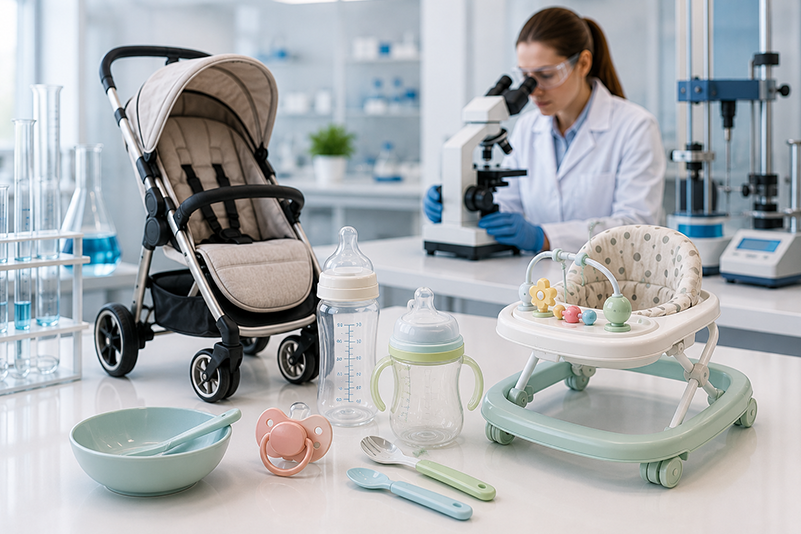
Before a soother, sippy cup, or pushchair reaches a nursery shelf in the UAE, it has to prove it won’t hurt the child using it. That proof comes from child care products testing. At Testhub Laboratories, our EIAC-accredited, ISO/IEC 17025-certified lab in Jebel Ali, Dubai, runs the full range of tests these products need: chemical migration, nickel release, mechanical strength, and flammability, against the EN standards that GCC regulators and international retailers expect on a compliance file. Whether you’re a manufacturer entering the UAE market, a distributor sourcing from overseas, or a retailer checking a new supplier before stocking their line, this is where that testing gets done and documented.
Soothers & Pacifiers
A soother sits in a baby’s mouth for hours a day, sometimes for months on end. Any chemical that migrates out of the rubber or silicone under that kind of repeated contact ends up in the child’s body, not on it. That’s why pacifier safety testing sits among the most tightly regulated child care product categories and why GCC authorities want to see it cleared before a soother crosses customs.
What we test:
- Migration of volatile N-nitrosamines and N-nitrosatable substances from rubber teats, per EN 1400 and GSO 2016.
- Extractable and migratable elements from the teat and shield material.
- Pull strength on the teat-to-shield bond, checking for detachment and choking risk.
- Odour and taste transfer that can signal chemical breakdown in the material.
Any brand selling soothers or pacifiers into the UAE or wider GCC needs test reports against these standards on file. It’s the paperwork that clears customs, and it’s the record that protects the brand if a batch ever gets questioned.
Feeding Utensils & Cutlery
Spoons, forks, bowls, and training cutlery take more physical abuse than almost any other baby product. They get gnawed on, dropped, and twisted. Feeding utensils safety testing under EN 14372 covers those failure points, plus one chemical risk that catches a lot of manufacturers off guard: nickel.
What we test:
- Sharp points and edges on the utensil body and any metal fittings
- Small parts and detachment risk on handles, tips, and decorative attachments
- Torque and tension checks on joints, confirming they won't separate under a toddler's grip
- Drop testing that mirrors everyday handling and floor impact
- Nickel release testing per EN 1811 on any metal part that touches skin repeatedly, including handles, rivets, and decorative trims
Nickel release testing gets missed often because it’s easy to overlook. A utensil with exposed metal, even a small stainless tip or a decorative rivet, needs EN 1811 testing alongside the EN 14372 mechanical suite. This gap shows up in incoming compliance files more than most manufacturers expect.
Drinking Equipment (Sippy Cups & Feeding Bottles)
Sippy cups and training cups carry a similar risk profile to soothers: prolonged mouth contact, daily use, and materials that need to survive dishwashers, sterilizers, and hot liquids without breaking down. EN 14350 governs this category specifically.
What we test:
- Migration of elements and chemical compounds that could transfer into liquids or a child's mouth
- Volatile compound release from the cup body, spout, and valve
- Structural integrity of spouts and valves after repeated use and sterilization cycles
- Leak and spill performance under normal handling
These products carry both chemical migration risk and daily wear, so a full pass under EN 14350 usually needs both a lab chemistry check and a mechanical durability check before the product is market-ready.
Pushchairs & Prams (Wheeled Conveyances)
Pushchairs and prams are large, structurally complex products, but the question that trips up most importers has nothing to do with structure. Do pushchairs need chemical testing before sale in GCC markets? Yes. The fabric, plastic components, and painted or coated metal parts a baby’s skin and hands touch fall under EN 1888-1, and GCC customs and market surveillance bodies check this alongside the mechanical safety file.
What we test:
- Migration of lead, cadmium, chromium, and other regulated elements from fabric, foam padding, plastic trims, and coated metal
- Chemical screening on handles, harness buckles, and any part with sustained skin contact
- Documentation aligned to EN 1888-1 for customs clearance and retailer compliance checks
Manufacturers often focus heavily on the mechanical side of pushchair testing (brakes, harness strength, and folding mechanisms). The chemical migration component is a mandatory part of the same standard, and it’s worth budgeting for from the start rather than treating it as an afterthought.
Baby Walking Frames
Baby walkers bring together two very different hazards in one product: fire risk and physical structure. EN 1273 covers both, so testing under this standard looks at the frame, the fabric seat, and the wheelbase together.
What we test:
- Flammability of seat fabric and any soft trim components
- Dimensional and structural checks on the frame, wheel spacing, and stability under load
- Stair fall and tip over resistance
- Locking mechanism and brake performance where fitted
Walking frames get used on multiple surfaces in a home, so EN 1273 testing tends to run longer than a single lab visit. Most manufacturers going through this for the first time should plan for a round of testing, design adjustments, and a re-check before final sign-off.
Why Do Manufacturers Choose Testhub for Child Care Products Testing?
Getting child care articles testing UAE right the first time saves weeks of back and forth with customs and retailers later. Testhub runs EN 14372, EN 1273, EN 1888-1, EN 1811, EN 1400/GSO 2016, and EN 14350 testing under EIAC accreditation and ISO/IEC 17025 certification, all from one facility in Jebel Ali, Dubai. That means a single point of contact for chemistry, mechanical, and flammability testing across your full product range, instead of splitting samples across multiple labs and standards.
Get Your Child Care Products Tested in Dubai
Getting a child care product to market in the UAE or the wider GCC starts with the right standard tested by an accredited lab. Testhub Laboratories runs EN 14372, EN 1273, EN 1888-1, EN 1811, EN 1400/GSO 2016, and EN 14350 testing from our Jebel Ali facility in Dubai under EIAC accreditation and ISO/IEC 17025 certification.
Send us your product category and we’ll confirm which standards and tests apply before you ship a single sample.
FAQs
Yes, when the utensil has any exposed metal component that touches skin or mouth repeatedly, including handles, rivets, tips, or decorative trims. Nickel release testing under EN 1811 runs alongside the mechanical and physical tests required by EN 14372, and both are typically requested together for market entry.
Pacifiers and soothers are tested against EN 1400 (and the equivalent GSO 2016 standard used across GCC markets) for chemical migration and volatile nitrosamine release, plus mechanical pull testing on the teat-to-shield joint to check for detachment risk.
Yes. EN 1888-1 covers both the structural safety of pushchairs and prams and the chemical migration testing of fabric, foam, plastic, and coated metal parts that touch a child’s skin. GCC market surveillance checks both parts of the file, not just the mechanical one.