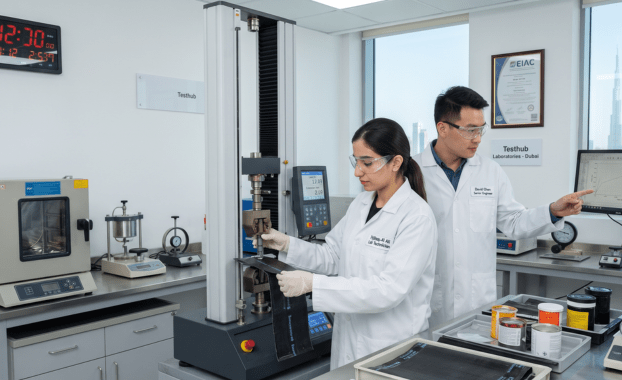
Waterproofing Testing in Dubai: When and Why
A basement slab that looked perfect on handover day starts weeping eight months later. By then the screed is down, the tiles are laid, and nobody wants to be the one who signs the opening-up instruction. This is the scenario waterproofing testing exists to prevent, and in Dubai the conditions make it a live risk rather than a theoretical one. Salty groundwater sits close to the surface in many coastal plots. Roof surfaces bake, then cool. Membranes move, and joints move with them.
So when does testing actually get required, and what does it tell you that a delivery note cannot?
Table of Contents:
Where Does the Requirement Usually Come From?
Three triggers cover most cases on a UAE site.
The first is specification. Consultants write test frequencies into the project spec, tied to standards such as ASTM methods for bituminous and liquid-applied membranes. The second is material approval. Before a membrane goes anywhere near a slab, the contractor submits it for approval, and a third-party report from an accredited lab is often part of that pack. The third is a performance check on the installed system, which is where flood testing comes in.
Manufacturers also test their own output. Testhub notes that its scope supports QC and production teams who want to see how a product is behaving in practice rather than on a datasheet.
What Waterproofing Testing Actually Measures
There is no single pass-fail button. A membrane is judged on several properties at once, and each one maps to a different way the system can fail on site.
Tensile strength and elongation tell you how much movement the sheet tolerates before it tears. Thickness and mass per unit area confirm you received the grade you paid for, not a thinner variant. Adhesion in peel looks at bonding, which matters at laps and upstands where most leaks begin. Crack bridging ability answers a blunt question: if the substrate cracks underneath, does the membrane stretch over it or split with it?
Then there is heat aging, water absorption, dimensional stability, and non-volatile content. Heat ageing carries obvious weight in this climate. Dimensional stability matters because a membrane that shrinks pulls itself away from detail work.
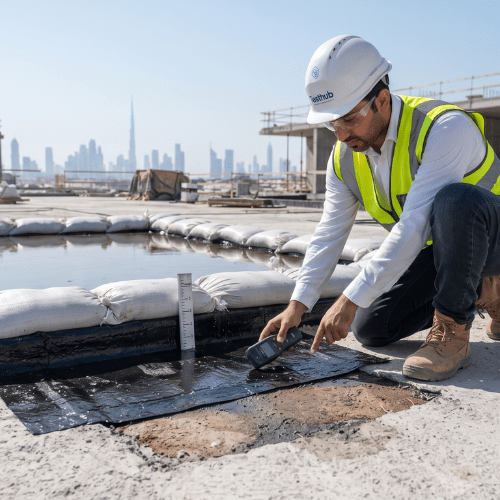
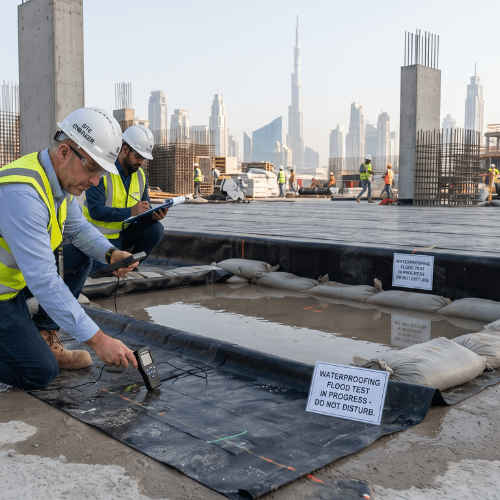
Flood Testing and the Installed System
Laboratory work covers the material. Flood testing covers the installation.
The method is unglamorous and effective. A finished area is dammed, filled with water, and left for a set period while the underside is watched for damp patches or drips. Roofs, podium decks, wet areas, and water tanks all get this treatment. Leakage tests and controlled water exposure tests sit alongside it, checking the same thing from different angles.
A flood test report is one of the few documents that reflects what was built, including the workmanship. Two identical membranes from the same roll can perform differently depending on how the laps were welded.
Membrane Types You Will Meet on UAE Sites
Bituminous membranes remain common for roofs, basements, and retaining walls, valued for durability and adhesive behavior. Liquid-applied membranes give a seamless finish and suit complex detailing. PVC and EPDM sheets bring long service life and UV resistance for exposed applications.
Each family has its own test set. Testing a liquid applied coating the way you would test a torch-applied sheet produces numbers that mean very little.
Why It Matters Beyond the Certificate
Water reaching structural concrete is not only a finished problem. Chloride-laden moisture at the reinforcement level starts corrosion, and corrosion is expensive and slow to reverse. Persistent damp also feeds mold growth in occupied spaces, which is a health matter rather than a cosmetic one. For guidance on damp-related indoor air quality, national health bodies publish material worth reading.
None of this means a test report predicts building performance. It reports what a specific sample or a specific area did under defined conditions on a given date. Design, substrate preparation, and installation quality all sit outside the scope of the sample. Treat results as evidence feeding a decision, not as a substitute for engineering judgment or for the advice of your consultant.
Timing and the Cost of Leaving It Late
Material testing belongs at the submittal stage, before bulk delivery. Flood testing belongs after installation and before protection screed or finishes go down. Miss that window and access becomes destructive.
Testhub Laboratories works from Jebel Ali and holds EIAC accreditation with ISO/IEC 17025 certified analytical services, which is the kind of detail consultants check when they review a report’s admissibility.
Final Thoughts
Waterproofing is one of the few building layers that gets buried immediately and judged years later. Waterproofing testing is how you shorten that feedback loop. Before your next pour, ask a simple question: if this membrane failed under the slab, how would anyone find out, and how much would it cost to reach?
FAQ
Two ways, really. In the lab you check tensile strength, elongation, adhesion in peel, thickness, crack bridging, water absorption, and heat aging on a sample. On-site you flood test the finished area and watch the underside. The lab tells you about the product. The flood test tells you about the install.
Depends on the spec and the area. The consultant sets the duration, and it is usually held long enough for water to find any weak lap or penetration. Check your project documents rather than assuming a standard figure, because durations differ between roofs, wet areas, and tanks.
Often yes. A manufacturer certificate covers a production batch under their conditions. Third-party testing on the material actually delivered to your site is a different piece of evidence, and many specs ask for both.
There is no single one. ASTM publishes separate standards for bituminous sheet membranes, flexible sheet membranes, and liquid-applied systems, and your spec will name the ones that apply. Worth confirming with your consultant before booking anything.
No. Ageing and absorption tests indicate how a material behaves under set conditions, and that is useful information. Service life depends on design, substrate, workmanship, and exposure, so nobody can turn a report into a lifespan figure.