Tile Testing in Dubai: Absorption and Breaking Strength
A tile can look flawless in the showroom and still crack under a loaded trolley, or soak up water once it is laid. Tile testing in Dubai exists to catch that gap early. Two measurements sit near the top of most lab reports: water absorption and breaking strength. Here is what each one tells you, where the other lab checks fit, and how to read a report without second-guessing every line.
Table of Contents:What Water Absorption Tells You
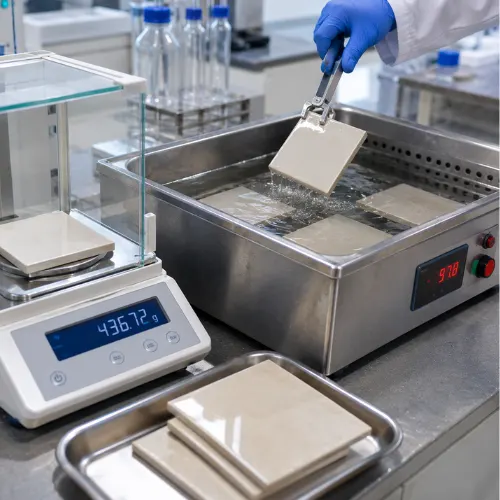
Water absorption shows how much water a tile body takes in after soaking. A dense tile drinks very little. A porous one takes in more, which points to a more open internal structure.
Labs rarely report it alone. Water absorption, density, and apparent porosity are tested together because all three describe how compact the material is on the inside. Read them as a set rather than hunting for one favorable number.
Absorption figures can also help explain results elsewhere. Stain resistance and frost resistance are separate tests, yet a tile that holds more water has more to lose in both. If a report shows high absorption and a weak stain result, the two may well be linked.
Breaking Strength and Modulus of Rupture
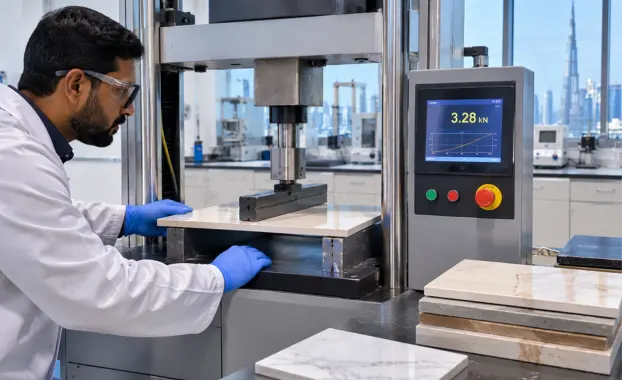
Breaking strength is the force a tile can carry before it fails. It is measured on equipment such as a universal testing machine, which sits alongside environmental chambers, digital microscopes, and X-ray fluorescence spectrometers in a well-equipped stone and tile laboratory.
Modulus of rupture is listed as its own test, separate from breaking strength. Check which of the two a supplier quotes before comparing one product with another. Mixing them up is an easy mistake and a costly one.
Impact resistance and abrasion resistance round out the mechanical side. Impact covers a sudden knock, such as a dropped tool. Abrasion covers the slow surface wear that foot traffic causes over years.
What a Tile Testing Report Usually Covers
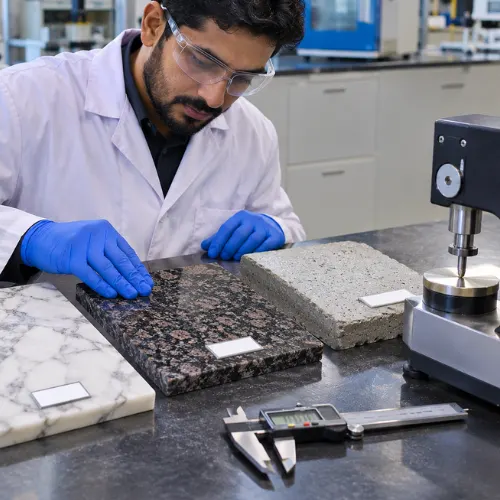
Past the two headline numbers, the scope for tiles and marble runs wider. Size and finish come first, meaning dimensions and surface quality. Heat and cold have their own checks: linear thermal expansion, thermal shock resistance, and frost resistance. Chemistry closes the list with chemical resistance, stain resistance, and lead and cadmium content. Mohs hardness sits with the wear tests.
Not every project needs every test. A bathroom wall and a paved forecourt put different demands on the material, so the specification should set the list.
Natural Stone and Paving Blocks Behave Differently
The same scope covers granite, marble, slate, sandstone, limestone, travertine, and other natural and artificial stone. Stone varies widely in physical and mechanical properties, so a result on one sample says little about another batch.
Marble shows the point well. It usually sits at 3 to 4 on the Mohs scale, a 1 to 10 ranking of mineral hardness, so it scratches more readily than granite. It also reacts with acids, and lemon juice can etch or stain it.
Granite gets a different set of checks: hardness, porosity, abrasion resistance, chemical resistance, and impact resistance. Paving blocks fall under the same laboratory scope.
Reading Results Without Overreaching
A report describes the samples that were tested. Treat tile testing as evidence about those samples, not a verdict on every box delivered to the site. Compare each figure with the standard named in the report and with the project specification.
Check the laboratory’s accreditation too. In the UAE, EIAC accreditation and ISO/IEC 17025 are the references to look for, and the test method used should sit inside the lab’s accredited scope.
Floors and walls that fail can hurt people and cost serious money. A lab report should sit alongside advice from a qualified engineer or consultant; never replace it. Everything here is general information, not project-specific advice.
Final Thoughts
Absorption tells you how a tile handles water. Breaking strength tells you how it handles load. Neither means much without the rest of the report and a specification to measure against. Testhub Laboratories, an EIAC-accredited lab in Jebel Ali, Dubai, runs these checks on tiles, marble, granite, natural stone, and paving blocks. Which number do you check first when a tile report lands on your desk?
FAQ
Pretty simply. They soak a tile sample, then work out how much water it picked up compared with its dry state. It usually gets reported next to density and apparent porosity, so you can see how tight the material is.
Depends on where it goes. A wall tile and a driveway paver face very different loads, so the project specification sets the target. Breaking strength is the number you check against it, and modulus of rupture is reported separately.
Softer. Marble sits around 3 to 4 on the Mohs scale, so it scratches more easily than granite. It also reacts to acids, which means a splash of lemon juice can leave an etch mark.
Usually hardness, porosity, abrasion resistance, chemical resistance, and impact resistance. Labs can add others depending on the job. Get the full list your specification calls for before you send samples.