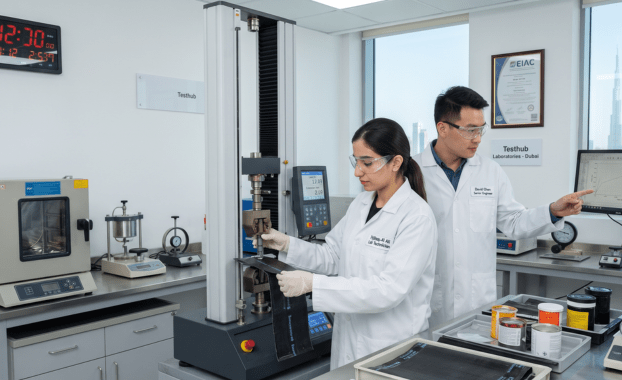
Migration Testing in Food Packaging: A Dubai Guide
Jebel Ali handles a large share of the packaging materials that move through Dubai’s food supply chains, from imported plastic containers to locally molded trays. Migration testing in food packaging is the process that checks whether chemicals from those materials transfer into the food they hold. For manufacturers, importers, and retailers working across the UAE, this testing sits at the center of whether a product can legally reach a shelf.
Plastic packaging looks inert on the surface. Underneath, it carries additives, residual monomers, and processing aids that can move into food under heat, acidity, or long storage. That movement is called migration, and regulators split it into two categories worth understanding before any product goes to market.
Table of Contents:
What are Overall Migration Testing and Specific Migration Testing?
Overall migration testing measures the total amount of substance that transfers from a packaging material into a food simulant, regardless of what that substance actually is. It gives a broad compliance figure, a ceiling on how much material can leach out under defined conditions of time and temperature. Specific migration testing works differently. It isolates named substances, things like bisphenol A, phthalates, or primary aromatic amines, and measures their individual transfer levels against set limits.
Both approaches matter because a plastic container can pass an overall migration check while still releasing a single harmful substance above its individual limit. Internationally, overall migration methods are commonly grouped under the BS EN 1186 series, while specific migration methods for named substances in plastics fall under the BS EN 13130 series, giving labs a shared reference point for how a sample should be prepared, exposed, and measured. Testhub Laboratories in Dubai performs both overall migration compliance testing and specific migration testing as part of its food contact material services, alongside physical characterization and screening for substances that were never intentionally added to the material in the first place.
Why Do Plastics Get Extra Scrutiny?
Plastic resins used in food contact applications, whether for water bottles, takeaway containers, or cling film, are formulated with plasticizers and stabilizers that food-grade paper or glass simply do not contain. Trace metals and bisphenol screening are part of Testhub’s chemical testing scope for exactly this reason. A packaging supplier bringing plastic trays into the UAE market needs data showing these substances stay under their thresholds, not an assumption that the resin is safe because it looks and feels like standard food packaging.

What Does Migration Testing in Food Packaging Actually Cover?
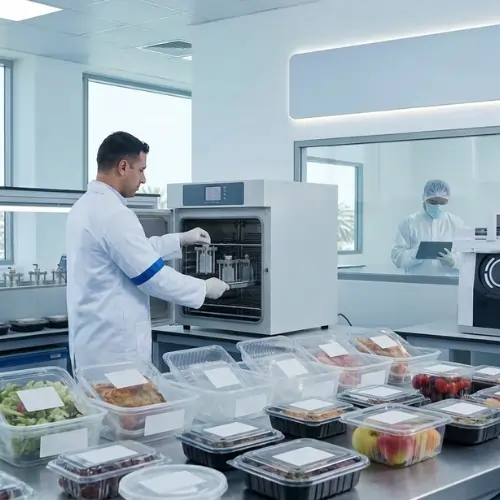
A migration test typically places the packaging material in contact with a food simulant, a liquid chosen to behave like the food it will actually hold, fatty, acidic, or aqueous, under conditions that mimic real use. Hot fill, microwave reheating, and long-term ambient storage each produce different migration results from the same material, which is why the simulant and the exposure conditions have to match how the product will actually be used.
Testhub’s laboratory in Jebel Ali runs this testing alongside physical characterization of the packaging itself, checking properties like thickness and barrier performance that influence how much a substance can migrate in the first place. The lab also screens for non-intentionally added substances, a category that covers breakdown products and contaminants that were never part of the original formulation but can appear anyway.
Reading a Migration Test Report
A completed report should separate overall migration results from any specific substances tested, state the simulant and conditions used, and compare each result against the applicable limit. Manufacturers exporting food packaging out of Dubai, or importing finished plastic products into the UAE, use these reports to demonstrate compliance to buyers, retailers, and regulatory bodies who ask for documented proof rather than a verbal assurance.
Getting Packaging Tested in Dubai
Food contact material testing generally starts with sending representative samples of the finished packaging, not raw resin, since the finished product’s shape, coating, and printing can all affect migration behavior. Testhub Laboratories works with plastics, ceramics, paper, board, rubber, silicone, glass, and metal packaging materials, running the chemical and physical tests needed to evaluate compliance with food packaging regulations.
Businesses supplying supermarkets, hotels, and food manufacturers across the region increasingly get asked for this documentation before a contract is signed, not after a complaint is filed. Building migration test data into a product launch timeline, rather than treating it as a final step, tends to save weeks when a retailer’s compliance team asks for evidence.
Final Thoughts
Migration testing in food packaging is not a formality tucked into a compliance checklist. It is the data that separates packaging a company assumes is safe from packaging it can prove is safe, and that distinction matters the moment a retailer, auditor, or regulator asks a direct question. If your packaging has not been tested against both overall and specific migration limits, what would you tell a buyer who asked to see the results?
FAQ
Yes, most plastic, rubber, and coated packaging materials used for food need migration testing before they can legally reach the market. Regulators and retailers both ask for documented results, not assurances, especially for imported packaging where the resin formulation was set overseas and never verified locally.
Overall migration measures total substance transfer without naming what transferred. Specific migration isolates named substances, like bisphenol A or phthalates, and checks each one against its own limit. A material can pass one test and still fail the other, so most labs run both together for a complete compliance picture.
A week, sometimes two. That’s the honest range for a standard overall and specific migration panel in Dubai, running from the day a sample lands at the lab to the finished report. Add more substances to the screening list, though, and the timeline stretches further.
Definitely. Overall migration only measures total mass transferred, not what that mass is made of. A container could stay under the overall limit while one specific substance, such as a plasticizer, still exceeds its individual threshold, which is exactly why both tests exist side by side.
Generally yes. Retailers and food manufacturers in the UAE increasingly request migration test reports before signing a supply contract, and customs or municipal checks can also ask for this documentation, so it is worth testing before shipment rather than after a shipment gets flagged.