Asphalt Testing in Dubai: Lab Checks for Road Quality
Dubai’s road surfaces sit under direct sun for most of the year, with pavement temperatures at the surface regularly passing 60 degrees Celsius during peak summer months. Asphalt testing is what determines whether a mix can hold up under that heat, plus the weight of constant traffic, before a single truck ever drives over it. Skip the testing, and a contractor is guessing. Run it properly, and there’s data behind the decision.
Testhub Laboratories, based in Jebel Ali, Dubai, carries out material testing across the physical, chemical, and mechanical properties of construction materials. Asphalt sits alongside cement, aggregates, and concrete in that scope, tested using laboratory methods rather than assumptions or visual checks on site.
Table of Contents:What Does Asphalt Testing Actually Check?
Asphalt is not a single substance. It is bitumen bound together with layered aggregate, and each component behaves differently under heat, load, and moisture. Asphalt material testing looks at how well those components hold together once mixed and compacted.
A few things get evaluated in the process:
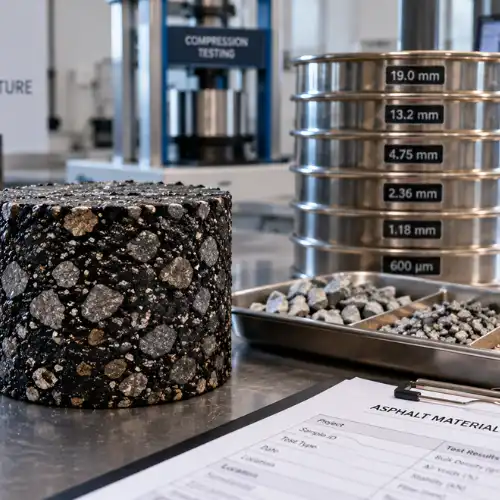
Bitumen content tells a lab how much binder is present relative to aggregate, since too little leaves a brittle mix and too much leads to rutting under heavy vehicles. Aggregate gradation, checked through sieve analysis, shows whether particle sizes are distributed the way the mix design calls for. Moisture susceptibility testing checks whether water exposure will strip the bitumen coating away from aggregate over time, a problem that shows up as potholes long after installation.
None of these checks happen by eye. They require calibrated equipment and a controlled lab environment, which is part of why Testhub operates from a purpose-built facility rather than a mobile setup alone.
Common Laboratory Tests for Asphalt Pavement Testing
Asphalt pavement testing usually runs through a sequence rather than a single pass. Extraction testing pulls the bitumen out of a compacted sample to measure exact binder content against the design mix. Softening point testing shows the temperature at which bitumen shifts from solid to soft, a figure that matters directly for a climate where surface heat runs high for months at a time.
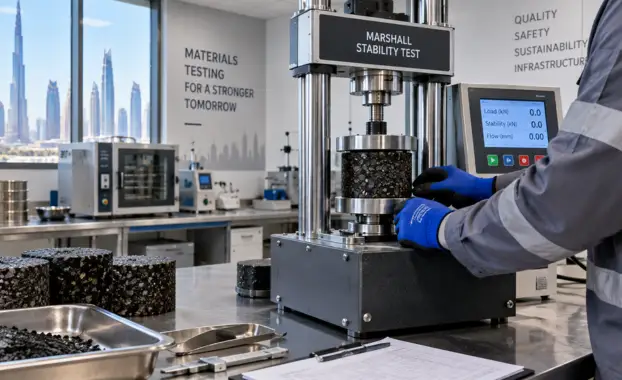
Compaction density testing checks how tightly the mix packs down, since under-compaction leaves voids that let water and air in. Marshall stability testing, still one of the most widely used methods worldwide, measures how much load a compacted sample can take before it deforms.
Testhub’s scope covers mechanical testing for strength and durability, chemical analysis to verify composition, and physical testing for performance, the same categories that apply directly to asphalt evaluation. The lab also performs non-destructive testing and failure analysis, both relevant when a road section already in service needs investigation rather than a fresh batch before laydown.

Accreditation Behind the Results
A test result only carries weight if the process behind it can be trusted. Testhub Laboratories holds accreditation from the Emirates International Accreditation Centre and operates under ISO/IEC 17025, the international standard covering competence for testing and calibration laboratories.
That distinction matters for asphalt work tied to municipal contracts or infrastructure tenders, where a report needs to hold up against a regulator’s review, not just a client’s expectations. Accreditation does not guarantee a mix will pass. It confirms the lab followed a recognized method to reach its conclusion, which is a different and more useful thing.
Why Asphalt Testing in Dubai Carries Extra Weight
Asphalt testing in Dubai deals with conditions that differ from cooler climates where much of the standard testing literature originated. Extreme surface heat, high humidity swings near the coast, and near-constant heavy vehicle traffic on major routes all put additional stress on a pavement mix that a moderate climate would not.
Testhub extends its material testing services beyond Dubai to Abu Dhabi as well, covering soil, construction materials, and related testing for projects across both emirates. For contractors working across UAE job sites, that reach means one lab handling comparable projects under comparable conditions, rather than results from a facility calibrated for a different climate entirely.
Final Thoughts
Asphalt testing is not a formality tacked onto a project timeline. It is the difference between a pavement mix designed on paper and one verified against how it will actually perform once vehicles start driving on it every day. For engineers and contractors working on UAE infrastructure, that verification through an accredited lab is what stands between a spec sheet and a road that holds up. Which part of your current mix design still needs lab verification before the next pour?
FAQ
Turnaround depends on which tests are being run. A basic gradation or moisture check might come back within a couple of days, while a full mix design evaluation with extraction and stability testing takes longer. Ask the lab for a timeline upfront so it fits your project schedule.
Too little binder makes the mix brittle and prone to cracking under load. Too much leads to rutting, especially in hot weather when bitumen softens further. Getting that ratio right through lab testing avoids costly resurfacing down the line, which is far more expensive than testing before laydown.
Yes, and it often should be. Failure analysis on a section that’s already deteriorating can point to whether the original mix was wrong, whether drainage failed, or whether traffic load simply exceeded what the design accounted for. That answer shapes the repair approach.
It doesn’t change the physical result, but it changes how much weight that result carries. An ISO/IEC 17025-accredited report follows a recognized methodology, which matters when results go into a tender submission or a regulatory review rather than staying internal.
The lab flags which property falls short, whether that’s stability, gradation, or moisture resistance, and the mix design gets adjusted accordingly. Failing a test before construction is a far better outcome than discovering the same problem in a road that’s already been paved.