
Toy Safety Standards in the UAE: What GSO EN 71 Requires
Toy safety standards in the UAE run through one reference point: GSO EN 71. Any toy sold in Dubai, Abu Dhabi, or elsewhere in the GCC has to clear three parts of that standard before it reaches a shelf or an online cart. For manufacturers and importers, that means a mechanical check, a flammability check, and a chemical migration screen, each tied to a clause number a customs officer or a buyer can ask for by name.
Table of Contents:What Are the Three Parts Behind GSO EN 71 Requirements?
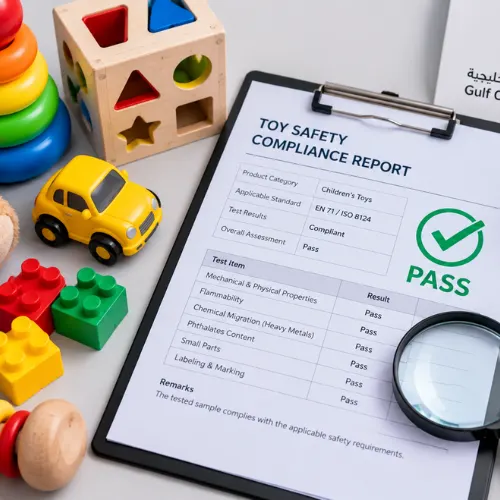
GSO EN 71 is the Gulf Standards Organization’s adopted version of the EN 71 toy safety series. Most products need all three parts. Toy testing labs typically run them as one combined panel rather than three separate submissions, which saves a manufacturer the back-and-forth of sending samples twice. Each finished report names the exact clause tested and gives a pass or fail against it, so the paperwork holds up whether it goes to a procurement officer, a retail buyer, or customs.
GSO EN 71-1: Mechanical and Physical Properties
This part looks at the physical hazards a child meets during ordinary, and not so ordinary, play. Small parts that could choke an infant. Sharp edges and points. Cords, elastics, and joints that get twisted, dropped, and pulled apart by curious hands. Labs measure this with specific rigs: a small parts cylinder, a torque meter for the simple torsion test, a drop test onto a steel plate, and a sharp edge tester, among others. Anything aimed at children under three gets the closest scrutiny here, since that age group is most likely to mouth a toy or a detached piece.
GSO EN 71-2: Flammability
This part measures how fast a toy catches fire and how the flame moves across it once it does. Soft toys, costumes, hair accessories, and anything with pile fabric or loose trailing material get flagged for a closer look, since those materials burn differently than rigid plastic. Each sample is checked against the burn rate limits set out in the standard, using dedicated flammability testing equipment.
GSO EN 71-3: Migration of Certain Elements
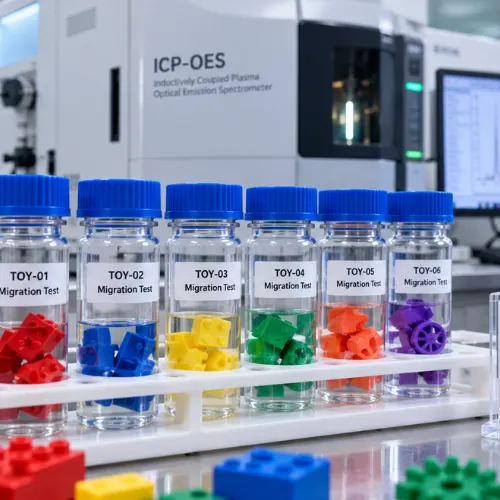
This is the chemical safety check, and it covers a longer list than most people expect: lead, cadmium, chromium, arsenic, barium, antimony, and several other elements. Labs put paints, coatings, plastics, and modelling compounds through simulated saliva and gastric conditions, since that mimics what happens when a toy actually goes in a child’s mouth. The extracted samples then go through ICP-OES analysis to confirm the released amounts stay under the permitted limits. Migration testing on multi-material or multi-colour toys usually takes a little longer, because each colour or material gets tested on its own rather than as a blended sample.
G-Mark Certification and UAE Toy Safety Standards Compliance
Regulated toys need G-Mark conformity before they can legally sell in the UAE, and that certification depends on having the GSO EN 71 test data ready first. A lab report on its own does not equal a G-Mark. It is the evidence that feeds the conformity file the certifying body reviews. This distinction trips up a lot of first-time importers, who assume a passed test result is the finish line rather than a required input.
Toy manufacturers preparing a production run for export, importers clearing shipments into the UAE, brands entering the market for the first time, and e-commerce sellers who need compliance evidence before a listing goes live all rely on this same three-part testing process. An ISO/IEC 17025 accredited laboratory, such as TestHub Laboratories in Jebel Ali, Dubai, carries out this testing and issues reports built around the specific clauses each product needs.
Final Thoughts
Toy safety standards in the UAE are not a single certificate. It is a testing sequence with three distinct parts, feeding into a separate conformity mark, each with its own timeline. Knowing which part applies to your product and which age group it is intended for is usually the difference between a smooth customs clearance and a shipment held up for retesting. If you are preparing a toy line for the UAE or GCC market, what part of GSO EN 71 are you least sure your current product would pass?
FAQ
Budget 7 to 15 working days for a standard three-part panel from the day the lab receives your sample. Migration testing under EN 71-3 can run longer on toys with several colours or materials, since each one gets tested separately rather than as one combined sample.
Most toys need all three: mechanical, flammability, and chemical migration. A lab can usually run these as a single combined panel instead of three separate submissions, which keeps you from shipping samples back and forth.
No, and this trips people up often. The test report is the evidence your conformity file needs. G-Mark itself is a separate certification step handled through ESMA, and it depends on having that testing data in hand first.
Anything marketed to children under three faces the most detailed mechanical checks, since that age group is most likely to put small parts or detached pieces in their mouth. Soft toys and pile fabric items get extra attention under the flammability part instead.
Toy manufacturers prepping an export run, importers clearing shipments into the UAE, new brands entering the market, and e-commerce sellers needing compliance evidence before a listing goes live all go through the same three-part process.