Soil Testing for Construction: The Step You Can’t Skip
Drive past Jebel Ali’s industrial belt and you’re driving over sabkha, loose sand, and reclaimed ground, sometimes all three within the same plot. That mix is precisely why soil testing carries so much weight in Dubai. A building only ever performs as well as the ground holding it up. Skip the analysis and every structural calculation above ground becomes a guess wearing an engineer’s stamp. What does soil testing for construction actually involve?
Samples get pulled from the site, sent to a lab, and returned as hard numbers on texture, moisture, and load-bearing capacity. Foundation depth, pile design, and whether the plot needs ground improvement before a column goes in all trace back to those numbers.
Table of Contents:
Why Does Soil Composition Determine Foundation Design?
No plot is uniform, not even within itself. One corner might rest on dense sand while another sits over soft clay pockets left by old drainage patterns decades ago. A geotechnical soil investigation maps this layer by layer instead of treating the whole site as one block.
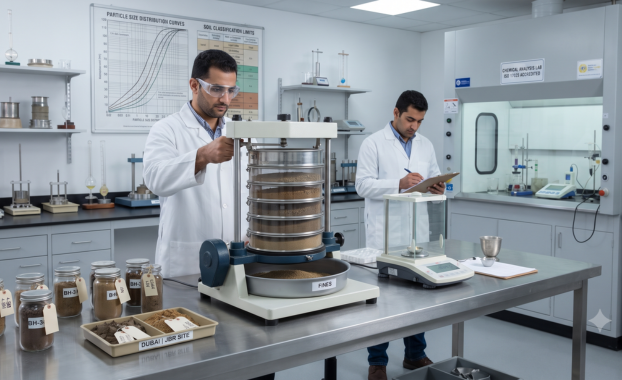
Texture analysis breaks each sample down into its sand, silt, and clay ratio. Clay holds water and swells. That swelling shifts foundations over time, sometimes by millimeters a year, which is enough to crack a slab eventually. Sandy soil drains quickly instead, but it can compact unevenly once heavy loads sit on top of it. The foundation strategy, whether that’s a raft slab or deep piling, depends entirely on which of these you’re actually building on.
Moisture content complicates things further. Soil sampled during a dry spell reads differently than the same soil after rainfall, so labs record moisture at the time of collection and account for seasonal swings. A quick on-site check never replaces this. It can’t.
The Chemical Side: pH, Salinity, and Contamination Risk
Mechanics only tell half the story. Chemistry decides the rest. Soil pH influences how concrete and buried steel age over the decades a building stands. Acidic or alkaline conditions speed up corrosion in rebar and, in some cases, degrade waterproofing compounds faster than anyone accounted for at the design stage.
Salinity is its own concern along the Gulf Coast, where saline groundwater migrates upward through capillary action, slowly and mostly unnoticed until it isn’t. Elevated chloride levels in soil or groundwater are a documented driver of reinforcement corrosion in concrete, a pattern confirmed in durability research from the American Concrete Institute. Testing chloride content and total dissolved solids before construction catches this risk while it still costs almost nothing to design around.
Then there’s contamination. Heavy metal and organic contaminant screening exists for a specific reason: land that once hosted industrial activity, waste storage, or farming chemicals doesn’t always look contaminated. It just is. Buried contamination affects both long-term structural safety and worker exposure the moment excavation starts.
Load-Bearing Capacity and Compaction Testing
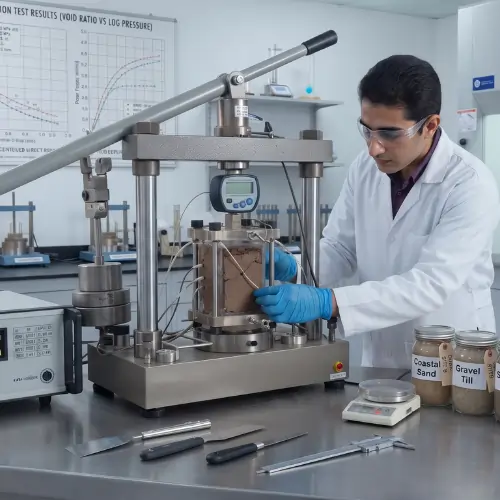
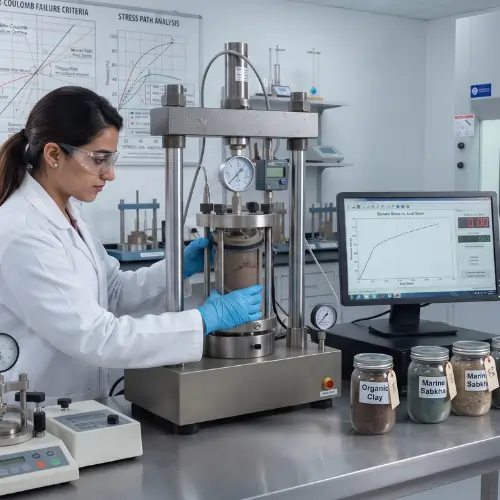
Every structural engineer waits on this number first. Load-bearing capacity tells you how much weight the soil can carry per unit area before it deforms or fails outright. Get it wrong, and a building settles unevenly. Walls crack. Structural joints take on stress they were never designed for, sometimes not showing up until years after handover.
Soil compaction testing measures how tightly particles pack together, which determines how the ground responds once real structural load sits on it. Loose or poorly compacted soil usually needs mechanical compaction, or full replacement, before any foundation work begins. Skip this step, and differential settlement follows, where one section of the building sinks faster than the rest.
Cation exchange capacity and organic matter content matter too, particularly on sites with any agricultural or landfill history. Both influence how soil behaves under sustained load long after the last vehicle leaves the site.
What Does Soil Testing for Construction Report Actually Cover?
A real report never stops at one number. Expect breakdowns across pH, moisture, chloride and salinity levels, heavy metal concentrations, organic content, and particle size distribution, all measured at multiple depths and points across the plot. Structural engineers plug this straight into foundation calculations. It isn’t background reading.
Testhub Laboratories in Jebel Ali runs this kind of soil and sludge analysis under ISO/IEC 17025-accredited methods, covering everything from contaminated soil and industrial waste streams to routine pre-construction samples. Their scope spans pH, moisture, chloride, oil content, heavy metals, and organic analysis, including TPH and BTEX. That range gives engineers the full chemical and physical picture before design work even starts.
Final Thoughts
Soil testing for construction costs a fraction of what a foundation redesign costs once cracks show up years later. Every plot in the UAE carries its own mix of composition, salinity, and contamination risk. None of it shows up by eye. So what does your current site data actually tell you about what’s underneath it?
FAQ
Depends on scope. A standard geotechnical soil analysis with chemical and physical testing usually runs several working days once the lab has samples in hand. Contamination screening can stretch that further if the site history is complicated. Build the wait time into your schedule early, and it stops being a bottleneck later.
Not really, no. Soil composition can shift dramatically over a few meters, especially on reclaimed land or anywhere the geology is mixed to begin with. Your plot needs its own samples from multiple points. Anything less and you’re building on assumptions, not data.
Engineers redesign around it rather than walking away from the site. That might mean deeper foundations, pile systems, or ground improvement techniques like compaction grouting. Which option makes sense comes straight out of the test results, not guesswork.
It does, even though the scope shrinks compared to a commercial job. Load-bearing capacity and moisture behavior still apply to a single-family foundation. Skip the test on a small build and you’re carrying the exact same settlement and cracking risk, just at a smaller scale.
Usually, yes. Contamination and salinity sit below what a visual inspection can catch. Chloride levels and heavy metal presence only show up under lab analysis, and both quietly affect concrete durability for decades after the building’s already standing.