

Concrete Cube Test in Dubai: 7-Day vs 28-Day Results
Two numbers decide how a lot of concrete gets judged. One arrives in 7 days; the other at 28. A concrete cube test produces both, and each answers a different question. Read them the wrong way, and a team either panics early or relaxes too soon. This guide explains what each result means for builders, architects and contractors in the UAE, and where the reading ends and an engineer’s judgement begins.
Table of Contents:What a Cube Sample Actually Measures
Concrete is judged largely on how much load it carries before it gives way. That property is compressive strength, and it falls under mechanical testing, the branch of lab work that also looks at hardness and ductility in other materials.
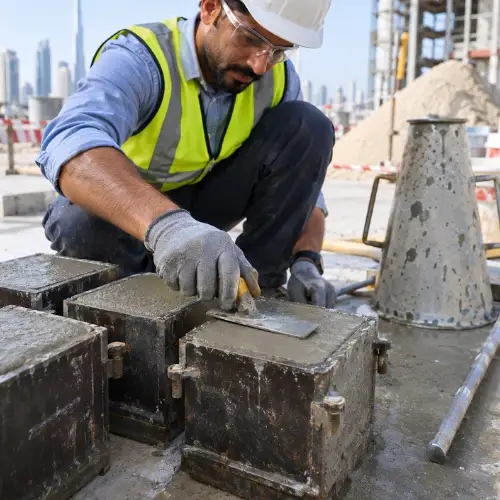
A sample is cast from the mix, cured, then loaded in a testing machine until it fails. The lab records the load and reports the strength. Laboratories that handle building material testing run this alongside checks on cement, aggregates, asphalt, steel and soil.
Think of the sample as a stand-in. The cube is small, but the result is read as a signal about where the pour came from.
How to Read the 7-Day Result
The 7-day figure is an early check, not a verdict. It shows whether the concrete is gaining strength along a believable path. Site teams use it to decide what to watch next, nothing more.
A low number at this age does not condemn the batch. It sends the team back to look at the mix, the curing, the casting conditions and how the sample was handled, then to wait for the next result. Seven days leave room to adjust. It does not leave room to judge.
A strong early number is welcome too, though it cannot promise the final outcome on its own. Treat it as encouraging news and keep the file open.

How to Read the 28-Day Result
The 28-day figure is the benchmark that a project specification is usually checked against. The specification for your own job names the exact age and the required strength, so confirm both with your engineer before anyone signs off.
The reading itself is plain. Compare the reported strength with the strength the design calls for. Then confirm the result came from a laboratory working to recognised standards, with the sample details, test age and measured strength clearly stated, so the number can be traced back to a specific pour.
If the figure meets the design value, the question is settled. If it falls short, the next move is an investigation, not a debate.
Where a Concrete Cube Test Fits in Quality Control
A concrete cube test result is one data point in a larger picture. Construction material testing exists to confirm that a material meets its specification or suits its intended use, and it helps teams avoid costly failures and meet regulatory requirements.
When a result raises doubts, other tools exist. Non-destructive testing detects flaws and irregularities without damaging the structure, and failure analysis investigates why a material underperformed. Neither replaces the cube result. Both give engineers more to work with.
Accreditation earns its place here. A strength figure is only as dependable as the process behind it. In the UAE, the Emirates International Accreditation Centre, known as EIAC, accredits laboratories for material testing. ISO/IEC 17025 is the international standard for laboratory competence. A report from an accredited lab hands the engineer a result that can be traced and questioned.
What a Useful Report Gives the Project Team
Speed counts on a live site. Prompt results support timely decisions, and a clear report keeps those decisions grounded. A good one carries up-to-date figures, names the test age and states the measured strength without padding.
Teams in Dubai and Abu Dhabi can ask the lab about these details before the first sample is cast, not after the first surprise. Agree who receives the report, who reads it against the design, and who has the authority to act on it. That small piece of planning saves more arguments than any single test.
Final Thoughts
Seven days shows direction. Twenty-eight days sets the benchmark. Neither replaces the structural engineer, who decides what a result means for the project in front of them, and this article is educational, not engineering advice. One example of a UAE laboratory working in this area is Testhub Laboratories, an EIAC-accredited facility in Jebel Ali, Dubai, whose scope covers concrete, steel, asphalt and aggregates among other construction materials.
Which result on your current project is still waiting for an answer, and who is the right person to take it to?
FAQ
It shows the compressive strength of a concrete sample, meaning how much load it takes before the sample gives way. Results come at two ages, 7 days and 28 days.
Not on its own. A low figure is a reason to review the mix, curing and sampling, then watch the 28-day result. Your engineer makes the call.
That is the age most specifications use as the benchmark, so the design strength gets checked against that result. Ask your engineer which age your project specification names.
Don’t guess. Send the report to your engineer, who may ask for non-destructive testing or failure analysis before deciding the next step.


